What are the signs of a failing sewer line?
Drains that keep clogging, a sewage smell, and basement backups, often after heavy rain or heavy water use. A sewer guide from the City of Rolling Meadows, Illinois (PDF), lists those same three signs.
- The basement floor drain, the lowest opening on the line, backs up when a toilet flushes or the washer drains.
- Clogs that return soon after snaking. That often means the pipe itself is failing, and snaking may clear the blockage only for a while, notes the City of Ann Arbor, Michigan.
- Backups after heavy rain. Stormwater that gets into sanitary sewers can cause residential backups, the Northeast Ohio Regional Sewer District (NEORSD) notes, so tell your city as well as your plumber.
What you can safely check yourself
- Run one fixture at a time and watch the basement floor drain. Stop at once if water rises there.
- Find your cleanout or test tee, a capped pipe in the basement floor or the yard, so a camera can get in. Do not open it while the line is backed up.
- Stop there. Do not rent a drain machine for the main line: Ann Arbor warns a cutter can damage fiber pipe. Do not dig either; Ohio law requires whoever digs to notify OHIO811 first.
If a smell is like rotten eggs and you are not sure it is sewage, treat it as a gas leak: get everyone outside without touching light switches, phones, garage door openers or anything else that could spark, call 911 or your gas company from a safe place, and do not go back in until they say it is safe. Keep out of sewage near outlets, cords, the furnace or the water heater: standing water around equipment is an electrical hazard. Sewage carries germs: the CDC says to wear rubber boots, rubber gloves and goggles if you must go into it, keep it off any open wound, and wash your hands after contact. Disinfect with 1 cup of bleach in 1 gallon of water and throw away what cannot be disinfected, like rugs, cloth and drywall. For more than a small puddle, the EPA advises getting help from qualified professionals if you can. If sewage or water reached the furnace or the water heater, do not relight or restart it even after it dries: the CPSC says a gas control valve that has been under water must be replaced, so have a qualified technician inspect it first.
What does a sewer camera inspection show?
A sewer camera inspection, often called a sewer scope, sends a camera in through a cleanout to show the inside of the lateral, joint by joint: what failed and where.
The footage can show the common problems NEORSD lists, and more:
- Roots coming in at joints
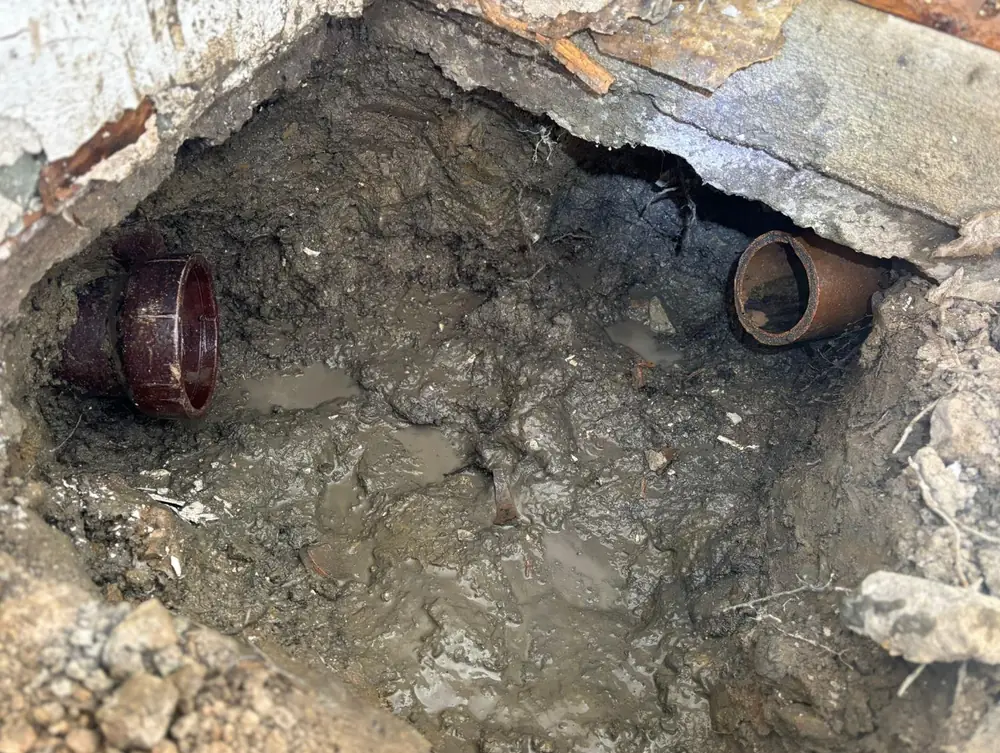
- Cracked, collapsed or offset pipe, often from shifting soil or frozen ground
- A belly: a sagging section where water and waste sit
- Grease or other blockages
- The pipe material, which video may help identify from interior damage patterns, Ann Arbor notes
- Whether the camera can reach the city sewer
We camera the line before quoting any drain or sewer repair.
Spot repair or full replacement: what decides it?
How many defects the camera finds, how spread out they are, and the condition of the pipe between them. NEORSD says cleaning or spot repairs usually handle it, but a line too far gone may need replacing.
| Spot repair | Full replacement | |
|---|---|---|
| What the camera shows | One or two defects in otherwise sound pipe: a root entry, a cracked section, a short sag | Defects repeating along the line, pipe out of round, several breaks |
| What gets replaced | The failed section only | The run from the house to the connection |
| The trade off | Smaller dig, but the old pipe around it keeps aging | Usually a bigger dig and more restoration, but the replaced run has no old pipe left to fail |
Orangeburg pipe is the exception to spot repair: Ann Arbor says that in many cases replacement is the only workable option.
How much does it cost to replace a sewer line?
No single number fits every house: depth, length, what sits on top of the pipe and whether the work reaches the city connection set the price.
| Cost driver | Why it matters |
|---|---|
| Depth | A sewer drains by gravity, so a line that leaves the house below the basement floor, or meets a deep city main, needs a deeper trench. |
| Length | A house set back from the street has more pipe to replace and more ground to open. |
| What is above it | Driveways, sidewalks, tree lawns, patios and mature trees have to be opened or worked around, then restored. |
| Inside the house | A break under the basement floor means cutting concrete. We open the smallest workable area and bag debris as we go. |
| The city connection | Work in the right of way follows city rules. Cleveland requires a sewer builder's license and bond for any work on a sewer connection. |
| Other buried lines | Whoever digs must notify OHIO811 at least 2 working days ahead, not counting weekends, legal holidays or the day of notice, and private and service lines may need a private locator. |
What is Orangeburg pipe, and what do clay and cast iron laterals mean for an older house?
Orangeburg is fiber pipe that flattens with age, clay lets roots in at its joints, and cast iron can corrode. In Ann Arbor, the city says, Orangeburg was used from roughly the early 1950s until the early 1970s, when plastic pipe became more common.
Many neighborhoods here are far older than that: NEORSD names Cleveland and the inner ring suburbs as the older parts of its service area, where combined sewers, a common early 1900s design, are most common. And clay is still in use: Cleveland's guidance says its ordinance calls for clay at the city sewer connection.
| Material | What it is | How it usually fails |
|---|---|---|
| Vitrified clay | Fired clay pipe. | Roots enter at cracked joints and spread them over time. |
| Cast iron | Heavy iron pipe. | Corrosion or deterioration. NEORSD says older pipe, or any pipe other than PVC, is at risk of deteriorating and collapsing. |
| Orangeburg | Bituminous fiber pipe: plant fibers and asbestos soaked in a tar-like material. | It weakens with age and soil pressure flattens it out of round; solvents poured down drains can make it fail from the inside out. |
| PVC | Modern plastic pipe. | The material NEORSD treats as the lower risk choice. |
Because Orangeburg contains asbestos, do not cut, break or sand it yourself; leave its removal to the replacement crew.
Who is responsible for the sewer lateral from the house to the main in Northeast Ohio?
You are, at least on your own property, and your city decides where your part ends. NEORSD's responsibility diagram gives the homeowner everything inside the home and from the home to the street, your city the local sewers, and the District its interceptors and treatment plants, with a footnote that actual ownership may vary. Two examples:
- Cleveland: a city Urban Forestry memo says each homeowner is responsible for maintaining the lateral, the pipe from the house to the main sewer, which is usually at the street.
- Solon: the city code section on inspecting and cleaning laterals (1042.27) limits the city's part to the stretch from the easement or right of way line to the main. The city will not take on cleaning if the house has no test tee.
Ask your city, before work starts, where its part begins and what permit it needs, especially outside the District's service area. NEORSD says the Cuyahoga County Sanitary Engineer handles sewer maintenance fully or partly in most Cleveland suburbs; Cleveland and the rest use their own departments.
Is there a lateral cost share or grant?
Not a general one from NEORSD, as far as the District's own pages showed on September 30, 2026. Its Community Cost-Share Program and Member Community Infrastructure Program fund member communities, not homeowners.
The closest is a Plumbing Repair Program on its cost-saving programs page, for emergency service line replacements and other plumbing repairs: owner-occupied homes, income limits, once every two years, run through CHN Housing Partners. Ask CHN whether it covers a sewer lateral, and ask your city about its own programs.
Is sewer line insurance worth considering?
It can be, for an older house with original pipe or trees near the line. But "sewer line insurance" usually means one of two different products.
| Product | What it pays for | What to check |
|---|---|---|
| Sewer backup coverage, an add-on to homeowners insurance | Losses to the house from a sewer or drain backup. The NAIC lists it as a common optional add-on. | Whether your policy already has it, its limit, and whether anything pays to fix the pipe itself. |
| Service line warranty or protection plan | All or part of repairs to lines that are your responsibility, which can include the sewer line | Pre-existing condition exclusions, repair caps, limits on how often you can claim, and deductibles. |
The Office of the Ohio Consumers' Counsel (OCC) notes these plans are often sold by third party companies, sometimes under the utility's name and logo. The OCC suggests asking your homeowners insurer first, since service lines may already be covered or available as a rider for less than a warranty costs. It adds that paying out of pocket can often cost less over time, but that homes in neighborhoods more than 40 years old where lines are still original and some have needed replacing, or with trees near buried pipes, may want to consider a plan.
When to call Raber HVAC
- Sewage is coming up into the house: stop running water in the house, keep people and pets away from it (rubber boots and rubber gloves if you must go near it, see above), stay out of water near outlets, cords or appliances, and call our 24/7 emergency line at (216) 888-4822.
- Drains keep clogging or backing up: book a camera inspection through our plumbing service.
For anything else, call (216) 888-4822, 8:00 AM to 10:00 PM every day, or book online and the office calls to confirm.
Sources
- Northeast Ohio Regional Sewer District (NEORSD), Common sewer problems and responsibilities
- NEORSD, Conveyance: The Sewer System
- NEORSD, Service Area and Facilities
- NEORSD, Cost-saving programs
- NEORSD, Community Cost-Share Program
- NEORSD, Member Community Infrastructure Program
- City of Cleveland, Treating Defective Sewer and Water Lines for Tree Roots
- City of Cleveland, Instruction Sheet for Sewer Builder's License and Bond
- City of Solon, Codified Ordinances Section 1042.27
- City of Ann Arbor, Michigan, Orangeburg Sewer Piping
- City of Rolling Meadows, Illinois, Sanitary Sewer Problems guide (PDF)
- OHIO811, Homeowners
- OHIO811, Private Utility Locating
- Enbridge Gas Ohio, Safety
- Columbia Gas of Ohio, How to Recognize a Gas Leak
- Centers for Disease Control and Prevention (CDC), Safety Guidelines: Floodwater
- U.S. Environmental Protection Agency (EPA), Flood Cleanup to Protect Indoor Air and Your Health
- U.S. Consumer Product Safety Commission (CPSC), Warning to Flood Victims: Replace All Gas Control Valves, Electric Circuit Breakers, GFCIs, and Fuses That Have Been Under Water
- Office of the Ohio Consumers' Counsel, What to Know About Utility Line Warranties
- National Association of Insurance Commissioners, Homeowners Insurance