
Why do galvanized pipes fail from the inside?
Because the zinc coating that protects the steel wears away, and then the steel rusts from the inside, where you cannot see it. The EPA describes galvanized pipe as iron or steel piping dipped in zinc to prevent corrosion and rusting.
The rust builds up as mounds on the inside wall, which an EPA research guidebook calls tuberculation, and those mounds shrink the space the water flows through. That is why a galvanized system often loses flow before it leaks: the pipe narrows inside while the outside can still look fine.
What are the signs a house needs a repipe?
One symptom can be local. Several together, in different parts of the house, point at the piping itself:
- Pressure that sags as soon as someone opens a second tap, or weak flow on more than one floor.
- Rusty or brown water at the first draw after the water has sat overnight.
- Aerator screens that keep clogging with grit and flakes.
- Rust stains, white or green crust, or drips at threaded joints.
- Old repairs where copper or plastic has been spliced into the steel.
- Pinhole leaks appearing in different places.
This article covers the water supply pipes; galvanized drain lines are a separate job.
Age is a clue. In Cuyahoga County, the Census Bureau's 2020 to 2024 American Community Survey estimates that about 56 percent of housing units were built before 1960. Repipes are common in the older housing stock all through this area.
What you can safely check yourself
- Confirm what the pipe is. Test a line you know carries water, such as at the meter or a faucet supply: a magnet clings to galvanized steel and the pipe will not scratch easily, says an EPA plumbing fact sheet. Old galvanized can look dark brown, gray or black, with threaded ends. Skip pipes running to the furnace, water heater burner or range: those may be gas.
- Note where the rust shows: hot, cold or both, so the water heater can be ruled in or out. Brown water across the house during hydrant flushing or water main work is iron sediment from older mains, Cleveland Water says; run the cold tap until it clears.
- Clean an aerator. If only one faucet is weak, rinse its aerator screen, where Cleveland Water notes small particles collect.
- Find your main shutoff so you can close it if a joint lets go, but only if you can reach it without stepping into water near outlets, cords or the electrical panel; otherwise stay out and call for help. The CDC says to be ready to turn off power where water stands. If an old valve will not turn by hand, do not force it; ask the plumber.
Stop there: leave tightening, cutting or forcing old joints to a plumber, since the system is under pressure. Leave any heavy wire clamped to a water pipe alone; it is likely electrical grounding or bonding.
Can you replace only part of the galvanized pipe?
Yes, but any galvanized you keep still restricts flow and sheds rust.
Where new meets old, the code sets the rules: Ohio's plumbing code adopts the International Plumbing Code, says the Ohio Board of Building Standards, and the 2021 International Plumbing Code requires a compression or mechanical sealing joint, a brass or other copper alloy fitting, or a dielectric fitting or union where copper joins galvanized steel, and approved transition fittings where plastic joins another material.
A partial job makes sense when only a short run of galvanized is left, or as a planned first phase, such as before finishing a basement.
Should you repipe with PEX or copper?
Either is a sound choice. PEX usually suits a repipe through finished walls, because it bends and long runs can be fished with fewer joints; copper suits exposed runs and spots where light or heat limits make PEX awkward. The code's table of water distribution pipe lists copper tubing (Types K, L and M) and PEX. The PEX limits below are Uponor's; other brands publish their own.
| PEX | Copper | |
|---|---|---|
| Joining | Mechanical fittings installed to the manufacturer's instructions; no flame, and no soldering within 18 inches | Lead free solder (0.2 percent lead or less), or press and mechanical fittings |
| Routing | Bends around corners, so fewer fittings | Mostly rigid lengths, so turns usually take fittings |
| Light | Limit sunlight; shield within 5 feet of direct view of fluorescent or LED lights | Not a concern |
| Electrical | Cannot be used as an electrical ground | Metal water piping is bonded to the electrical service |
If a ground or bonding wire clamps onto a metal water pipe, settle that first. Ohio's residential code adopts the National Electrical Code, whose rules, repeated in the International Residential Code, count metal underground water pipe in direct contact with the earth for 10 feet or more as a grounding electrode and require metal water piping to be bonded to the service. Replacing that pipe with PEX can break the ground or bond, so have a licensed electrician check it first.
What happens during a whole house repipe?
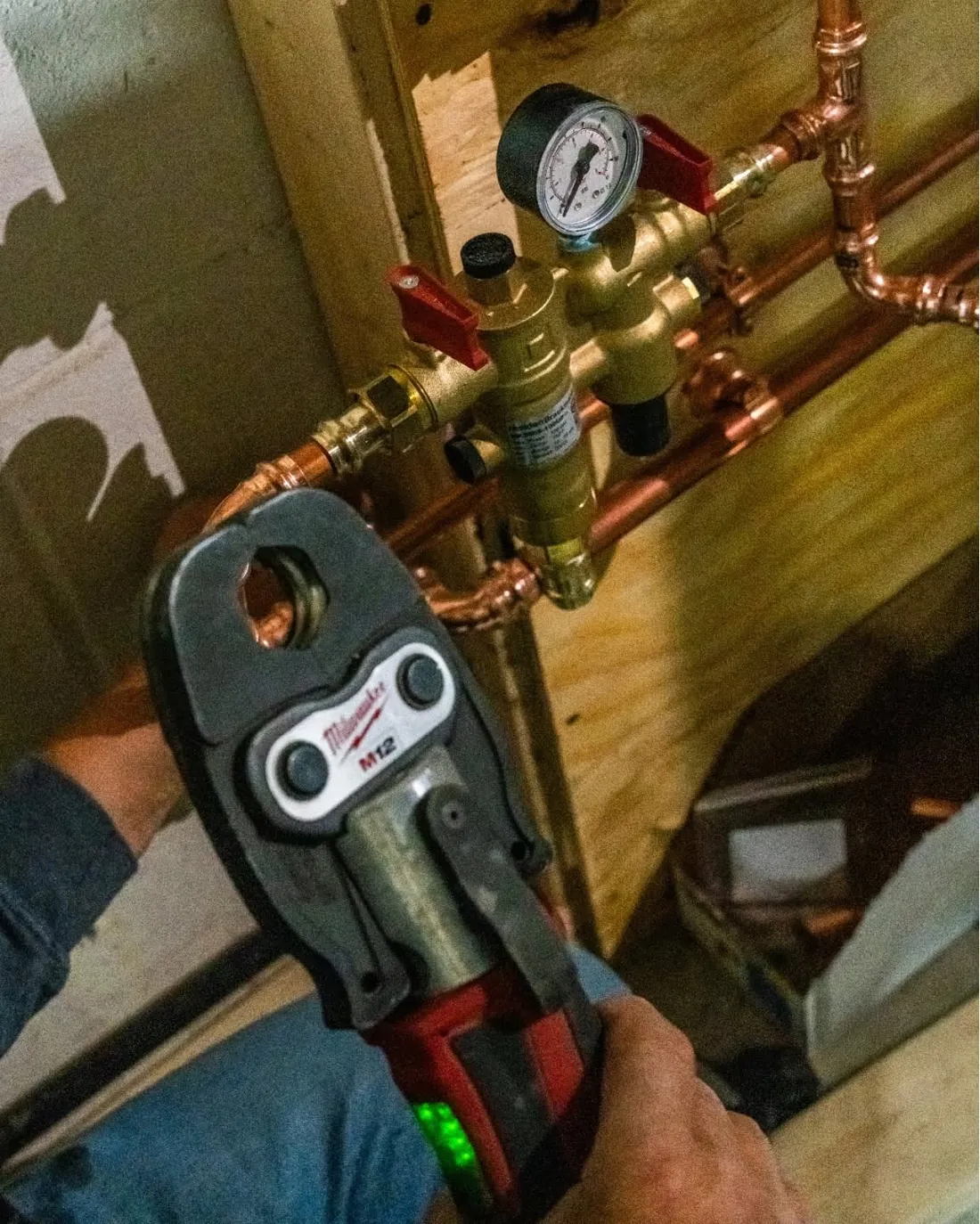
New lines are run to every fixture through access openings, often while the old pipe keeps the water on, then tested and switched over.
- Walkthrough and plan. Every fixture, the route to it, where any manifold goes, and which walls or ceilings open.
- Open access. Openings are cut where the new lines pass, often at closet backs, basement ceilings and behind fixtures.
- Run the new lines. The water may be off only for the tie ins; get the days and hours without water in writing.
- Test. The plumbing code requires the new piping to be proved tight with water at no less than its working pressure, or in some cases air at 50 psi or more, for at least 15 minutes. Ask whether a permit and inspection are required, and who arranges them.
- Flush and close up. New work can shake particles loose, so Cleveland Water advises cleaning aerators more often after plumbing work.
What drives the cost of a repipe?
Mostly the fixtures served, the number of floors, and how much finished wall and ceiling has to be opened, patched and painted, and by whom. Also:
- Whether the basement ceiling is open or finished.
- PEX or copper, and the manifold layout.
- New shutoff valves: the code calls for one on the supply to each fixture other than tubs and showers in a house, on each outdoor faucet and on each appliance.
- Whether the service line from the street is included, and any electrical bonding work.
- Permit and inspection requirements.
Should you repipe before finishing a basement or remodeling a bathroom?
Yes, if the supply is galvanized. With walls and ceilings open, access is easy; after the drywall goes up, the same pipe means cutting into new finishes. While the framing is open:
- Keep new lines out of outside walls: the code allows water pipe there only when insulation or heat protects it from freezing.
- Put any manifold where it stays reachable: the code requires access to manifolds with valves, and fixture shutoffs at a manifold must be labeled with the fixture they supply.
- Keep Uponor PEX at least 2 inches from light fixtures rated for contact with insulation (IC rated) and 12 inches from non IC rated ones, or protect it with approved insulation.
A single bathroom remodel is a partial repipe, so ask where the new pipe meets the old and with what fitting.
Can galvanized pipes affect lead in drinking water?
They can. The EPA plumbing fact sheet says scale inside galvanized pipe can collect lead from an upstream source, such as a lead service line, and release it later, and the zinc coating itself may carry traces of lead. A galvanized service line that is, or ever was, downstream of a lead service line can contribute lead even after the lead source is removed, the EPA also says.
- Find out what your service line is. If Cleveland Water is your utility, its service line map shows the material on record for your address, and its Lead Inquiry Line is (216) 664-2882; it says homes it serves built in 1949 or later should not have a lead city-owned line. If another utility serves you, ask what its records show.
- Know what a repipe does not cover. New pipes inside do not replace a lead service line, and the EPA notes that replacing one is often the responsibility of both the utility and the homeowner.
- Do not assume copper is lead free. The EPA says solder made or installed before 1986 contained high lead levels.
- Flush and drink cold. Until you know, run the cold tap before drinking when water has sat 6 or more hours, and use only cold water for drinking and cooking, as Cleveland Water advises.
- Test. To find out for certain, the EPA says, have your water tested; Cleveland Water points to the Ohio EPA's list of certified labs.
When to call Raber HVAC
If you have low pressure, rusty water or recurring leaks, do the magnet test, note which fixtures are affected, and call (216) 888-4822, every day from 8:00 AM to 10:00 PM, or book a visit online. We repipe with PEX or copper, and the same in house crew handles your plumbing and HVAC. For an active leak, close the main shutoff if you can reach it without stepping into water near electricity; if you cannot, your water utility can shut it off at the street (Cleveland Water: (216) 664-3060). Either way, call us at (216) 888-4822, our 24/7 emergency line, which also covers no heat and sewage backups.
Sources
- U.S. EPA, Final Lead and Copper Rule Improvements FAQ (2024)
- U.S. EPA, Sources of Lead in Drinking Water
- U.S. EPA, Know Your Plumbing! fact sheet
- U.S. EPA, Plumbing Volume Estimator Tool Guidebook (2024)
- U.S. Census Bureau, ACS 2020 to 2024 5-Year, Table B25034, Cuyahoga County
- U.S. CDC, Preparing for Floods
- Ohio Board of Building Standards, Ohio Plumbing Code Summary of Changes, 2017 to 2024
- Ohio Administrative Code 4101:8-34-01, Electrical (Cornell LII copy)
- International Code Council, 2021 International Plumbing Code, Chapter 6
- International Code Council, 2021 International Plumbing Code, Chapter 3
- International Code Council, 2021 International Residential Code, Chapter 36
- Uponor, PEX-a Installation Guide, 2nd ed. (April 2024), copy hosted by The Home Depot
- Cleveland Water, Check. Test. Date.
- Cleveland Water, Clean. Flush. Consume Cold.
- Cleveland Water, FAQs