Air conditioning repair and installation built for Ohio summers
Raber HVAC repairs, replaces and maintains central air conditioners, heat pumps and ductless mini splits in homes across Northeast Ohio. Summers here are humid more than they are brutally hot, so we size every system to pull moisture out of the air, not just drop the number on the wall.
- Same day AC repair when booked before 2 PM
- Diagnostics shown before any repair
- Properly sized replacements
- Ductless options for hard rooms
AC repair, replacement and ductless mini splits
Repairs, replacements and the maintenance that keeps a system out of the emergency queue in August.
AC repair
Capacitors, contactors, condenser fan motors, compressors and control boards. We test the electrical side before touching refrigerant, because most failures live there.
System replacement
Right sized condenser and coil matched as a pair, with a load calculation first. An oversized unit cools fast, never runs long enough to pull humidity out, and leaves the house clammy.
Ductless mini splits
A ductless mini split is a wall mounted indoor unit linked to an outdoor unit by a small line set, with no ductwork. Made for additions, attic conversions, sunrooms and the bedroom over the garage that central air never reached. One outdoor unit can run several indoor heads.
Refrigerant leak repair
We find and fix the leak instead of topping it off every June. Recharging a leaking system is renting cold air at a very poor rate.
Spring tune ups
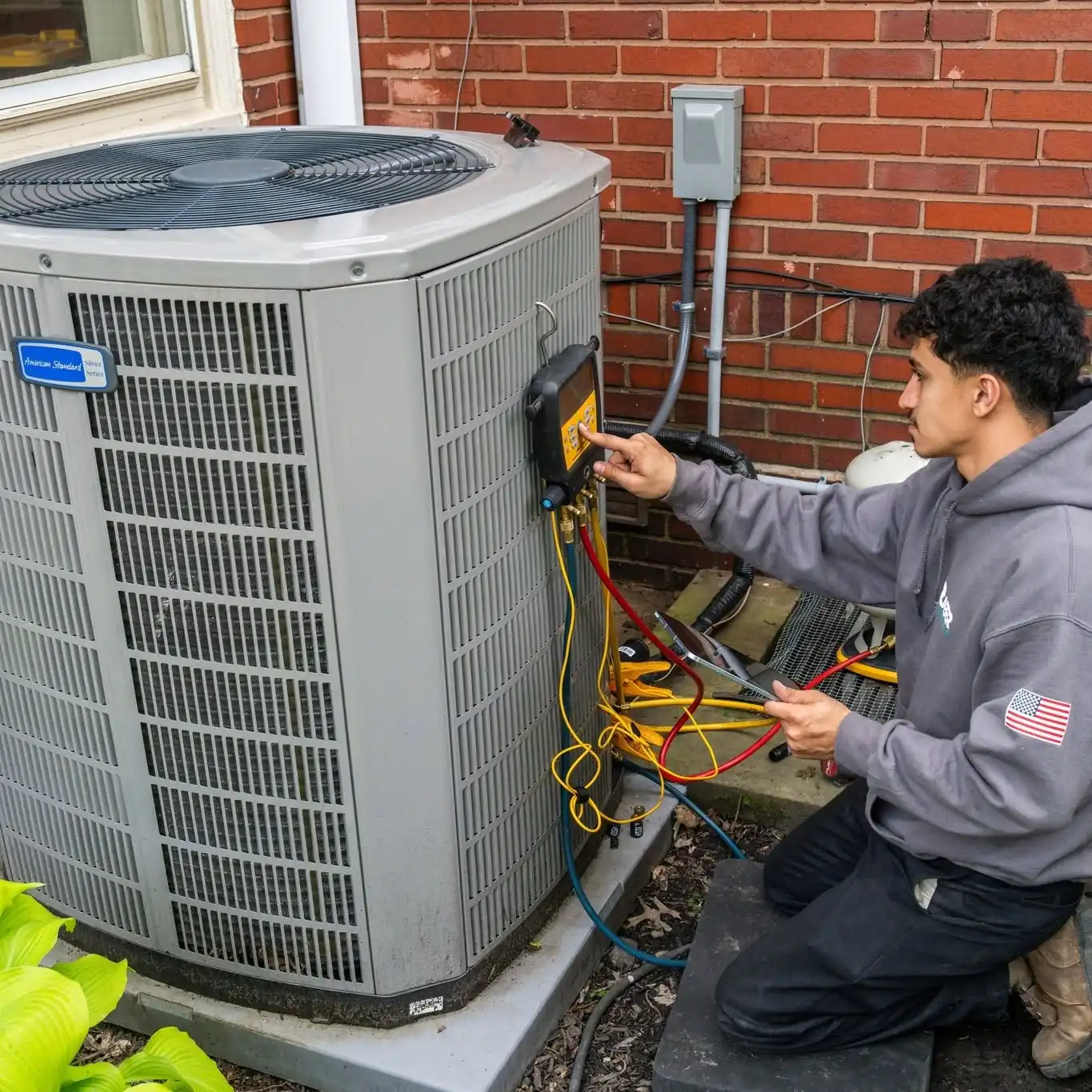
Coil cleaning, refrigerant charge verified by superheat and subcooling, capacitor tested under load, drain cleared and airflow checked.
Emergency cooling
Heat advisories are not a wait until Monday situation, especially in a house with infants or older adults. The emergency line is staffed all day and night.
Why a right sized air conditioner controls humidity
Two houses can sit at the same seventy two degrees and feel completely different. The difference is moisture, and moisture is a function of how long the system runs.
- A right sized system runs longer, slower cycles, and each cycle wrings water out of the air
- An oversized system blasts cold, hits the setpoint and stops before dehumidification really starts
- Variable speed and two stage equipment hold low output for hours instead of slamming on and off
- Leaky return ducts in a hot attic or crawlspace pull in humid air the system then has to fight
- Below roughly fifty percent relative humidity, most people are comfortable a degree or two warmer, which is where the savings come from
When the house stays damp even with a right sized system, a whole home dehumidifier is the next step. See indoor air quality.
Have your setup assessedWhat we measure on every AC call
- ·Superheat and subcooling, to verify charge properly
- ·Temperature split across the coil
- ·Static pressure on supply and return
- ·Capacitor capacitance under load
- ·Compressor and fan amp draw against nameplate
- ·Condensate drain flow and float switch function
Readings go on your invoice. Next season you can see what changed instead of taking anyone's word for it.
Should you repair or replace your air conditioner?
We are not interested in selling a system to a house that does not need one yet.
- Under ten years old with a single failed component: repair it, almost always
- A capacitor, contactor or fan motor is a routine part, not a reason to replace a system
- Two or more significant repairs in the same season on a fifteen year old unit: get replacement priced
- Failed compressor out of warranty on an older system: replacement usually wins on cost
- Any R22 system with a real leak: run both numbers before spending on refrigerant
Air conditioning questions from Northeast Ohio homeowners
If yours is not here, call and ask. We would rather answer it now than have you guess.
Why is my AC running but not cooling the house?
The usual suspects are a filthy filter choking airflow, a failed run capacitor so the compressor never starts, an iced evaporator coil, or a refrigerant leak. Start by checking the filter and looking for ice on the line at the indoor unit. If there is ice, shut the system off, leave the fan running to thaw it, and call.
How long does a central air conditioner last?
In the analysis behind the current federal efficiency standards, the U.S. Department of Energy put the average central air conditioner lifetime at about 21 years. Many are replaced sooner because repairs or energy bills make a new one the better deal. Salt and road spray in the winter are hard on outdoor coils, so rinsing the condenser each spring helps.
Source: U.S. Department of Energy, central air conditioner and heat pump standards (Federal Register, 2017)
Is a bigger air conditioner better?
No, and this is the most common mistake in the trade. An oversized unit satisfies the thermostat quickly, shuts off, and never runs long enough to pull humidity out. You end up with a cold, damp house, higher bills and a compressor worn out by short cycling. Correct sizing beats extra tonnage every time.
Is it worth repairing an R-22 air conditioner?
Sometimes. U.S. production and import of R-22 ended on January 1, 2020, so the refrigerant left is recovered, reclaimed or older stock, and it is expensive. You can keep running an R-22 system for as long as it lasts, but if it develops a significant leak, the refrigerant alone can cost more than the system is worth. We price the repair and a replacement side by side so the decision is yours.
Source: U.S. EPA, Residential Air Conditioning and the Phaseout of HCFC-22
Do I have to replace my R-410A air conditioner?
No. The EPA says an existing R-410A system can keep being repaired for its useful life, including replacing a failed condensing unit or indoor coil with a matching R-410A part, although refrigerant and parts may get harder to find over time. What changed is new equipment: U.S. manufacturers now build home systems around lower impact refrigerants such as R-454B and R-32. If an older R-410A system needs a major repair, we price the repair and a replacement side by side.
Source: U.S. EPA, Frequent Questions on the Phasedown of Hydrofluorocarbons
Can I add air conditioning without ductwork?
Yes. Ductless mini splits mount on the wall and connect to an outdoor unit through a small line set, so there is no need to tear open ceilings. They are quiet, efficient, zoned room by room, and they heat as well as cool.
How often should I change my furnace and AC filter?
A one inch filter every one to three months, and monthly if you have pets or allergies. A four or five inch media filter usually goes six to twelve months. A clogged filter is behind a surprising share of the emergency calls we run.
Why is water pooling around my indoor AC unit?
Usually a clogged condensate drain, or an iced evaporator coil that is melting. Check the filter first. If you see ice on the line at the indoor unit, shut the cooling off, leave the fan running to thaw it, and call. Standing water around equipment is an electrical hazard, so keep clear of it.
Where Raber HVAC works
Raber HVAC is based in Independence and serves Cuyahoga, Summit, Lorain, Medina, Lake, Geauga and Portage counties. Most of our work sits inside a forty minute drive. That is deliberate. A tight radius is what makes same day service possible instead of aspirational.
Including Independence, Cleveland, Parma, Strongsville, Brecksville, Broadview Heights, North Royalton, Seven Hills, Rocky River, Lakewood, Westlake, Cuyahoga Falls and the surrounding communities. See all 43 towns
Page last updated .
Book the tune up before the first heat wave.
Spring appointments are calm, cheap and quick. The same call in the middle of a July heat advisory is none of those things.
Every day, 8:00 AM to 10:00 PM · 24/7 emergency service · OH LIC #28728