
What to know first
- A heat pump installed in 2025 can still be claimed: on a 2025 return filed on extension by October 15, 2026, or on an amended return if you already filed.
- The federal Home Energy Rebates are separate from the tax credit. As of September 30, 2026 we could not confirm Ohio's are open.
- None of the three Ohio utility sites we checked lists a heat pump rebate for homes.
- This is not tax advice. Confirm your own return with a tax professional.
Is there still a federal tax credit for a heat pump in 2026?
No. The IRS says the credit covers improvements made through December 31, 2025, and its Instructions for Form 5695 say you cannot claim it "for expenditures or property placed in service after December 31, 2025."
The date comes from Public Law 119-21 of July 4, 2025, commonly called the One Big Beautiful Bill. The IRS fact sheet on the law shows it also ended the Residential Clean Energy Credit (25D), which covered geothermal heat pumps and solar, for expenditures made after December 31, 2025.
What counts is when installation was finished, not when you paid: Form 5695 treats costs as paid "when the original installation of the item is completed." A system paid for in December 2025 but installed in January 2026 does not qualify.
What if your heat pump was installed in 2025?
You can still claim it on your 2025 federal return, on Form 5695 Part II. The credit was 30 percent of the cost, installation labor included for heat pumps, with annual caps:
| Installed in 2025 | Most you could claim for the year |
|---|---|
| Heat pumps and heat pump water heaters, combined | $2,000 |
| Central air conditioner, or a gas, propane or oil furnace or boiler | $600 each |
| Panel, subpanel or circuit upgrade needed for the new equipment, rated at least 200 amps and installed to the National Electrical Code | $600 |
| Central air, furnaces, boilers, other water heaters, panel work, windows, doors, insulation and an energy audit, together | $1,200 |
| Everything together | $3,200 |
With dual fuel (a heat pump paired with a gas or propane furnace), a furnace also installed new in 2025 falls under a different cap, so both could count if each qualified. A furnace you kept does not.
The conditions to check
- A home you live in. For a heat pump, ENERGY STAR's tax credit page says it can be a U.S. home you use as a residence, including a second home. A renter who paid for the upgrade can qualify; a landlord cannot claim it for a rental they do not live in. A new home does not count.
- The efficiency tier. The heat pump had to meet the Consortium for Energy Efficiency's highest tier, not counting any advanced tier. For 2025 that meant ENERGY STAR Most Efficient air source heat pumps, through a cold climate path or a cooling and dual fuel path.
- The QMID. Report the manufacturer's four character QMID (qualified manufacturer identification number) for each item. For heat pumps, ENERGY STAR's federal tax credits page says that means the outdoor unit only.
- The paperwork. Keep the manufacturer's written certification that the product qualifies; do not attach it to the return.
- Rebates. Subtract any utility subsidy, and any rebate from the manufacturer, seller or installer, from the equipment's cost first.
- The limit. The credit is nonrefundable and cannot be carried to a later year.
If you requested an extension by the April deadline, the IRS gives you until October 15 to file: October 15, 2026, for a 2025 return. If you already filed without the credit, file an amended return on Form 1040-X, generally within 3 years after filing or 2 years after paying the tax, whichever is later.
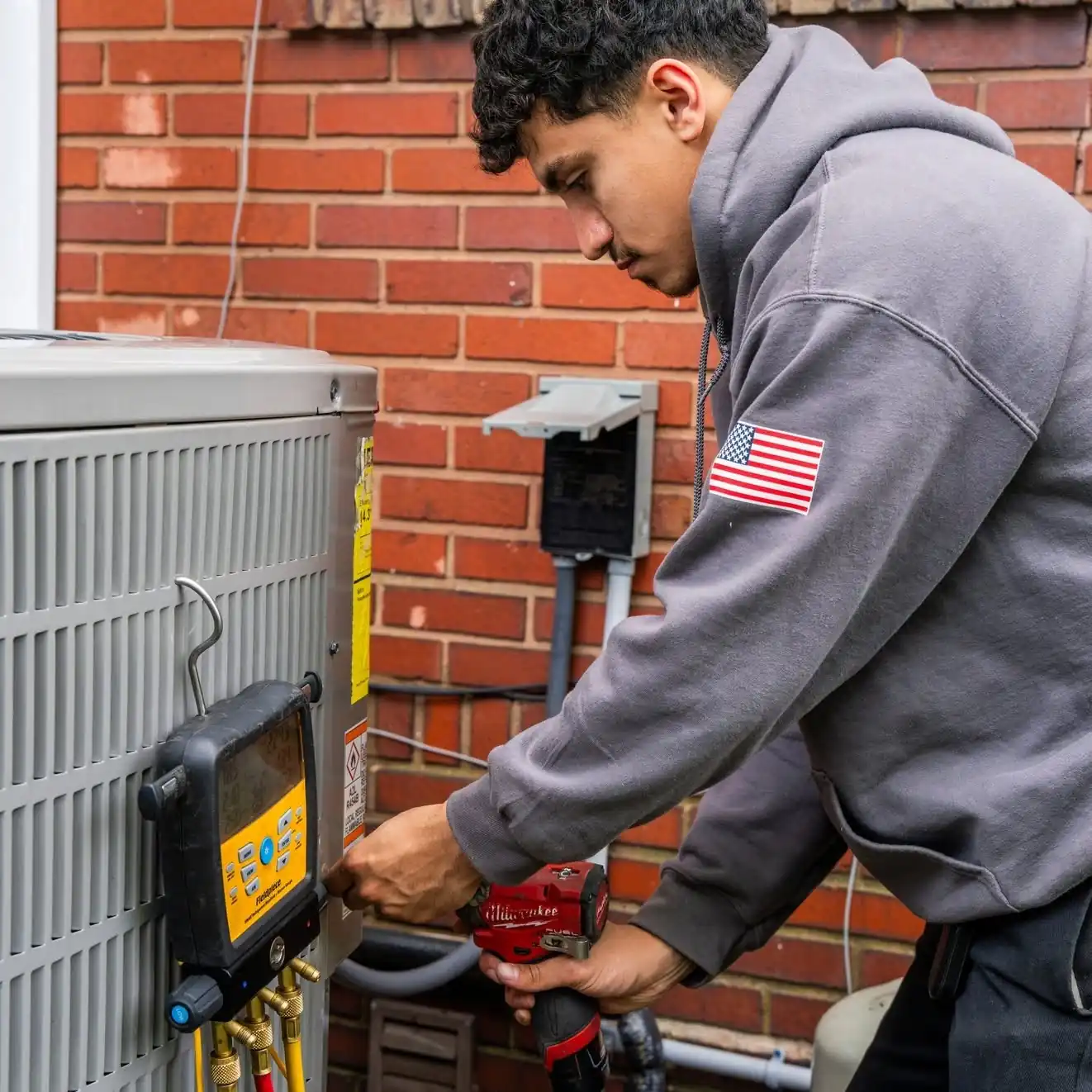
Give your tax professional the final invoice with the install date, the model numbers (on the outdoor unit's nameplate) and the manufacturer's certification. Read the nameplate from outside the cabinet; leave the electrical disconnect and breaker panel closed.
Did anything replace the 25C credit?
No. The IRS guidance names no new federal tax credit for home heating and cooling. What remains is the Home Energy Rebates from the Inflation Reduction Act of 2022: rebates run through state programs, not tax credits.
Are there Ohio heat pump rebates in 2026?
Not that we could confirm as of September 30, 2026. The U.S. Department of Energy's program page says the rebates are "now available in select states" and to ask your state energy office. In Ohio, 2024 state slides show the Ohio Department of Development planned to run them as the Ohio Home Energy Savings Program. We could not confirm it is taking applications.
The money was set aside but is not guaranteed. DOE allocated Ohio $249,026,150 for the two programs in 2022. On February 25, 2026 the U.S. House passed H.R. 4758, which would repeal HEEHR (not HOMES) and cancel its funds not yet committed. The bill went to a Senate committee and, as of September 30, 2026, had not become law.
| Program | Who it is for | What DOE listed in 2022 | Ohio, September 30, 2026 |
|---|---|---|---|
| HOMES (Home Owner Managing Energy Savings) | All income levels | Up to $2,000 for modeled savings of at least 20 percent, $4,000 at 35 percent; caps double for low and moderate income homes | Not confirmed open |
| HEEHR (High-Efficiency Electric Home Rebates) | Households under 150 percent of area median income, a federal limit | Up to $8,000 for a heat pump and $14,000 per household: up to 100 percent of the cost under 80 percent of area median income, 50 percent from 80 to 150 percent | Not confirmed open |
In May 2026 guidance, DOE renamed HEAR to HEEHR and told states to:
- Limit HEEHR heating and cooling rebates to replacing existing electric equipment with more efficient electric equipment.
- Let a home keep its gas, propane or oil system when a heat pump goes in.
- Require insulation and air sealing first, unless the home already meets a state set level.
HEEHR rebates cannot be combined with another federal grant or rebate for the same project, and DOE has said the law did not provide retroactive rebates under HEEHR (then called HEAR), so do not install first and count on one later. Before you sign, ask the Ohio Department of Development whether the program is open, whether you qualify, and whether your contractor must be on its list.
Do Ohio electric or gas utilities offer heat pump rebates?
None of the three we checked lists one for homes as of September 30, 2026.
| Utility | What its site lists for homes | Heat pump rebate |
|---|---|---|
| FirstEnergy (The Illuminating Company, Ohio Edison) | An energy analyzer, plus Community Connections and a no cost smart thermostat for customers who qualify by income | No |
| Enbridge Gas Ohio | The Housewarming Program: weather stripping, insulation and door sweeps for eligible customers | No |
| Columbia Gas of Ohio | Residential programs other than the income qualified WarmChoice program "have ended" | No |
FirstEnergy says its programs can change or end without notice, so check again before you buy. The ENERGY STAR Rebate Finder searches by ZIP code.
Does the end of the credit change whether a heat pump is worth it?
It changes the math by up to $2,000, the most the credit paid on heat pumps in a year. What decides it is how a heat pump runs in your house over an average life DOE put at about 15 years in its 2017 efficiency standards.
| Your house today | What a heat pump changes | What to weigh |
|---|---|---|
| Gas furnace, aging air conditioner | The heat pump replaces the AC and the furnace stays: dual fuel | Cools like an AC, heats when that costs less; the furnace takes deep cold |
| Electric baseboard or electric furnace | About 65 percent less electricity for heating than electric resistance heat, per DOE's home upgrades guide | Ducted or ductless, and room on the electrical service |
| Boiler, no ducts | Ductless mini split heads add cooling and mild weather heat | How many rooms need a head |
A heat pump's output falls as it gets colder, even for a model with ENERGY STAR's cold climate designation, which requires at least 70 percent of its 47 F heating capacity at 5 F. Northeast Ohio winters are long, so for most homes here we recommend dual fuel.
The cost of the job comes from the house: the size a Manual J load calculation (a room by room count of the heat your house loses and gains) calls for, the ductwork, the electrical work, the refrigerant line run and, for ductless, the number of heads. An on site quote gives the real number, and our heat pump and dual fuel page compares the options.
When to call Raber HVAC
We can compare a heat pump or dual fuel setup with a straight replacement for your house, size it and quote it on site.
Call (216) 888-4822, every day from 8:00 AM to 10:00 PM. The same number is our 24/7 emergency line for no heat, an active leak or a sewage backup. Or book online, pick a day and an arrival window, and the office will call to confirm.
Sources
- IRS, Energy Efficient Home Improvement Credit
- IRS, Instructions for Form 5695 (2025)
- IRS, Public Law 119-21 energy credit FAQs (FS-2025-05)
- IRS, Get an extension to file your tax return
- IRS, File an amended return
- ENERGY STAR, Federal Tax Credits for Energy Efficiency
- ENERGY STAR, Air Source Heat Pumps Tax Credit
- ENERGY STAR, Air Source Heat Pumps Key Product Criteria
- ENERGY STAR, Rebate Finder
- U.S. Department of Energy, Home Energy Rebates Program
- U.S. Department of Energy, Program Notice 26-2 (HEEHR), May 2026
- U.S. Department of Energy, Home Upgrades
- U.S. Department of Energy, state rebate allocations (2022)
- U.S. Department of Energy, Retroactive Rebate Resource (2023)
- Federal Register, DOE heat pump standards (2017)
- House Clerk, Roll Call 78 on H.R. 4758 (2026)
- GovInfo, H.R. 4758, referred in Senate
- Ohio Department of Development, Home Energy Savings Program slides (2024)
- FirstEnergy, Save Energy Ohio: For Your Home
- FirstEnergy, Ohio Companies Resume Efficiency Programs (2023)
- Enbridge Gas Ohio, Save Energy and Money
- Enbridge Gas Ohio, Housewarming Program
- Columbia Gas of Ohio, Energy Savings for Your Home
- ACCA, Manual J Residential Load Calculation